
More than half of business executives globally expect AI to displace jobs. Yet sectors with the highest AI exposure are not cutting headcount; they are reporting rapid economic growth and scrambling to hire for emerging AI talent.
The numbers tell a compelling story. According to a study by the European Commission, up to 6.5% of the EU’s workforce may need to transition to completely new occupations by 2030 due to AI workforce transformation.
This is not a gradual shift. It is a genuine talent race driven by generative AI skills.
Here’s where it gets interesting. In just one year, positions requiring generative AI skills have exploded across Europe:
- + 204% in Ireland
- + 120% in the UK
- + 109% in Germany
AI is not merely altering day-to-day responsibilities; it is fundamentally reshaping AI recruitment in Europe, changing how organizations identify, attract, and secure the talent they need.
The Reality Behind AI Workforce Concerns in Europe
Walk into any boardroom discussion about AI, and you’ll hear concerns about job losses. Data from the World Economic Forum supports that sentiment: 54.3% of executives anticipate AI will eliminate existing positions, while a mere 23.5% foresee it generating new opportunities. Another 44.6% point to higher profitability due to increased productivity.
Yet closer examination shows a more nuanced picture. In sectors like information and communications technology (ICT), AI is fuelling accelerated economic growth and strong job creation rather than widespread reductions. New positions are emerging rapidly, but they call for capabilities that differ substantially from the ones being phased out.
A displaced administrative assistant whose tasks have been automated, for example, does not automatically transform into a data analyst. That chasm between obsolete skills and emerging demands is where Europe’s real workforce challenge sits.
The Two Workforce Segments Transforming with AI in 2026
This transformation is reshaping both office and frontline workers in markedly different ways.
For desk-based professionals, digital fluency has shifted from optional to essential. Marketing teams now need campaign automation expertise. Sales professionals require predictive analytics capabilities. Finance teams work with automated reporting and forecasting tools. The shift is so pronounced that 81% of hiring managers now prioritize AI-related capabilities across every position, not just technology roles.
Then there’s the overlooked majority: roughly 2.7 billion workers globally who don’t sit at desks.
For decades, frontline employees have relied on paper schedules and coordinating through phone calls while office workers adopted successive layers of digital tools. That is now changing. AI-powered scheduling systems, 24/7 intelligent recruitment platforms, and real-time performance analytics are arriving in warehouses, retail floors, and service environments. Frontline supervisors increasingly need capabilities to manage technology-driven workflows they have not encountered before.
The Growing AI Talent Gap and Skills Shortage
The distance between what businesses need and what they can find continues to widen. Nearly 40% of employers in finance and manufacturing report their current workforce lacks necessary competencies for AI integration.
Workers recognize the gap as well. Six in ten employees anticipate needing to upskill in the coming years, and 44% worry they will not receive adequate preparation for working alongside AI.
According to a Hays report, 89% express willingness to participate in development programs, yet only 53% of companies say they provide training. This represents a significant missed opportunity.
What the IT Sector Reveals About Future Hiring Needs
Technology companies are already demonstrating how roles are evolving under AI. Consider how specific roles are evolving in tech:
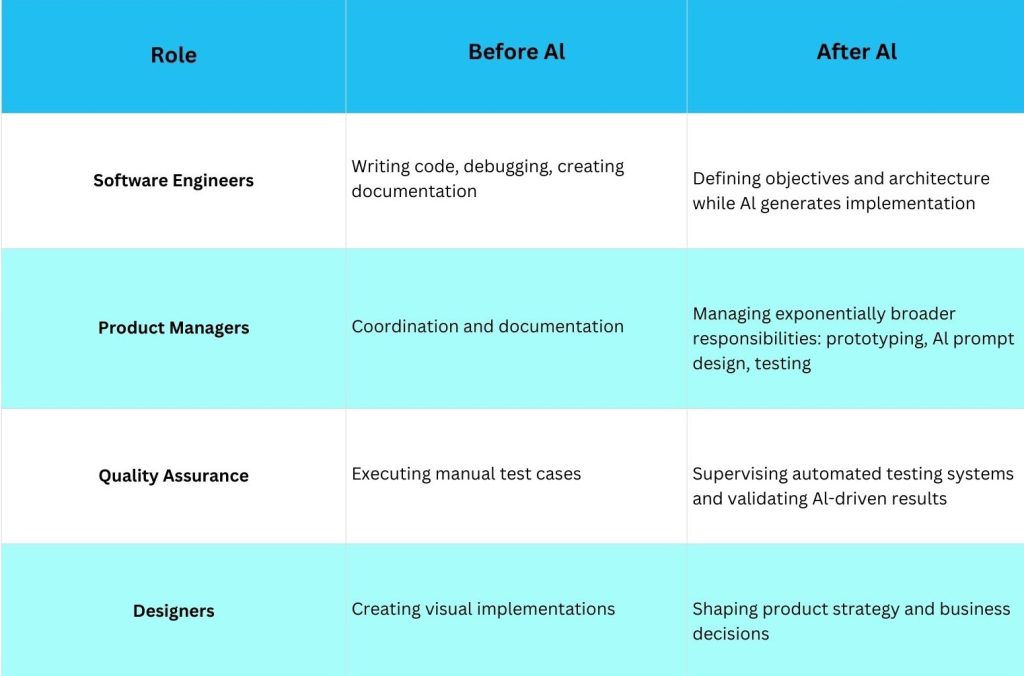
The pattern that matters for recruitment isn’t that specific jobs are changing. It’s how jobs are changing. Three trends will affect most organisations soon.
Trend 1: Role Boundaries Are Dissolving
Engineers now validate AI-generated specifications. Product managers prototype directly with AI tools. Designers step into product-level tasks that were previously outside their domain. The traditional function-based hiring model is becoming obsolete.
Recruitment implication: Seek hybrid skill sets, people who can work fluidly across traditional boundaries while leveraging AI tools.
Trend 2: Entry-Level Expectations Are Rising Dramatically
New hires are expected to contribute at substantially higher levels from day one as AI automates routine tasks. There’s a growing gap between what educational institutions produce and what AI-enabled roles demand.
Recruitment implication: Either adjust expectations and budgets accordingly or invest heavily in structured onboarding.
Trend 3: Teams Are Flattening as AI Embeds
Support-heavy roles like technical product managers, QA engineers, and sales development representatives are shrinking. Coordination layers are being replaced with shared tools and AI copilots.
Recruitment implication: Hire fewer people, but those individuals will need to be significantly more capable.
These patterns aren’t tech-specific. They’re already emerging in marketing (content creation, campaign management), finance (reporting, forecasting), operations (scheduling, logistics), and HR (recruitment, onboarding).
The timeline is important. If you’re not in tech, these shifts may arrive in full force within the next 12 months.
3 Essential Recruitment Strategies for the AI Era
Strategy 1: Developing Current Employees Through Upskilling
Upskilling the current team is most effective when started early. The problem? Many companies have already passed that window. Even when training is provided, there is often a gap between access to courses and the development of usable capabilities. Meaningful skill building requires months of structured learning, hands-on practice, and repeated application. Time that most businesses don’t have when AI transformation is already underway.
Recruitment implication: Upskilling can’t solve immediate talent gaps. It can provide long-term capability building while simultaneously bringing in external expertise to address urgent needs.
Strategy 2: Acquiring External Expertise
When AI transformation cannot wait for internal skill development, organisations face a build-versus-buy decision. The CEE region is seeing a surge in flexible talent arrangements that solve a specific problem: how do you access specialized AI expertise without the cost and commitment of permanent headcount?
Contracting addresses the need for speed. When a company needs someone who’s already implemented AI-driven workflows, they often can’t afford a six-month learning curve. Contract specialists arrive with battle-tested knowledge of what works and what fails. They don’t just execute. They transfer that knowledge directly to internal teams, driving impressive results.
Outsourcing solves the expertise gap problem. Some AI implementations require such specialized knowledge that building internal capability makes little economic sense. Outsourcing lets teams access that expertise precisely when needed, then move on.
Recruitment implication: Stop thinking about hiring as permanent-versus-temporary. Think about matching talent arrangements to specific business problems.
Strategy 3: Strategic Restructuring
Many companies approach restructuring by first eliminating routine roles, realising savings, and then discovering they lack the human oversight required for AI systems.
Here’s the trap: the accountant whose job got automated can’t suddenly become the AI governance specialist you need. You’re not redistributing work. You need to hire for a combination of domain expertise and technical fluency. These candidates are rare, expensive, and being pursued by every company in your industry simultaneously.
Recruitment implication: If restructuring is planned, prioritize strategic hires. Bring in AI oversight and product expertise before reducing execution roles, not after.
What This Means for Your Talent Acquisition Strategy Moving Forward
Europe’s workforce is transforming faster than traditional hiring can adapt. Role boundaries are dissolving, entry-level expectations are spiking, and the skills required today did not exist 24 months ago. The three strategies: upskilling, external expertise and strategic restructuring, work most effectively when in combination.
Orchestrating them effectively requires specialized knowledge of European talent markets, particularly in technology and AI-driven sectors where change is most pronounced. Recruitment partners must understand which skills matter, where to source proven AI talent, and how to act quickly.
At Verita HR, the team has developed deep expertise in exactly these areas. With strong roots in Poland and a track record of connecting businesses across Europe with high-calibre IT, technical, and AI talent, they help organizations navigate digital transformation and secure the capabilities they need to stay ahead.
Ready to change how your organization attracts and retains top talent in the AI era? Contact Verita HR today to discuss your specific needs and start building a future-ready team.
Author: Charley Mendoza


