Are you considering hiring remote talent in Poland in 2026 but overwhelmed by the remote work laws, social security (ZUS) contributions, tax residency rules, permanent establishment risks, and realistic salary expectations for IT and finance roles?
Poland offers employers a compelling mix of strong talent, competitive salaries, and a legal framework for remote work that protects both sides of the employment relationship.
But navigating the rules, contracts, taxes, and compliance takes more groundwork than most expect. This guide breaks down everything employers need to know before hiring remote Polish talent in 2026.
Who Can Work Remotely in Poland 2026?
Polish labor law treats remote work as a structured, regulated arrangement, not just a workplace perk. Any setup where employees work outside company premises qualifies, whether that’s fully remote or a hybrid schedule, provided both parties have agreed on the location.
Employers have a reasonable amount of discretion over most remote work requests. However, certain employees carry a legal right to it that employers can only refuse if the role genuinely cannot be performed away from the office.
That group includes:
- Pregnant employees
- Parents of children aged 4 and under
- Caregivers of disabled or severely disabled family or household members
- Parents of children with certified disabilities or special education needs
The Polish Legal Framework for Remote Employment
Poland has put real thought into how remote work operates legally. Several obligations are worth knowing upfront, particularly for foreign companies hiring remotely in Poland in 2026:
- Non-EU nationals need a valid work permit before their start date
- All employment contracts must be issued in Polish
- Anyone based in Poland for more than 183 days in a calendar year becomes a Polish tax resident, meaning their worldwide income falls under Polish tax jurisdiction
- ZUS, Poland’s social security system, applies to every employee regardless of where the employer is based
One area that catches foreign companies off guard is permanent establishment of risk. If a remote worker is handling contracts, driving revenue, or performing core business functions from Polish soil, local tax authorities may determine that the foreign company has a taxable presence there. Poland maintains double taxation treaties with many countries, so it’s worth checking whether the company’s home country is covered before finalizing any hiring decisions.
Why Putting Remote Work Arrangements in Writing is Crucial
Verbal agreements won’t hold up under Polish law; every remote or hybrid setup needs formal documentation. Employers have three routes to choose from:
- Include remote work terms directly in the employment contract from day one
- Issue a formal annex to an existing contract that updates the place or mode of work
- Develop company-wide remote work policies in consultation with employee representatives, then apply them to relevant roles
Those policies need to cover more than just location. They also include equipment provision and cost reimbursements, data protection measures, health and safety requirements and communication protocols.
Outside of declared emergencies, employers also cannot require remote work without the employee’s agreement. This means it must be a mutual decision.
Benefits Companies Must Provide to Remote Workers in Poland
Polish labor law sets clear expectations for what employers must provide remote workers. Equipment, running costs, and health and safety obligations all fall onto the employer’s plate, and none of them are optional.
On the equipment side, companies have flexibility in how they fulfill the obligation:
- Supply all necessary work tools and cover the costs directly
- Allow employees to use their own devices and pay them an agreed monthly allowance as compensation
- Cover repair and maintenance either by handling it yourself or reimbursing the employee through an agreed lump sum
Working from home generates real costs for employees. Under Polish law, employers are expected to offset these through a monthly reimbursement. This typically covers expenses such as electricity usage during work hours and internet access and ranges between PLN 30 and PLN 90 per month for fully remote workers.
Employers are also required to carry out an occupational risk assessment and provide written guidelines on safe workstation setup and emergency procedures. Once that’s done, the day-to-day responsibility for maintaining a safe workspace shifts to the employee.
In terms of broader employment rights and benefits, remote workers are entitled to the same treatment as on-site staff. This includes:
- Equal access to pay, promotions, training, and benefits
- Standard working hours including overtime entitlements and mandatory rest periods
- Proper tracking and compensation for any overtime or night work
Tax Responsibilities for Employers and Employees in Poland
Poland’s payroll tax system is straightforward once you understand how the costs are split. Both sides contribute, but the amounts, and who handles what, differ significantly. Here’s what employers need to know before making their first remote hire.
Employer Responsibilities
Employers’ direct tax obligation isn’t Personal Income Tax (PIT), that comes out of the employee’s salary. What employers also carry is the employer-side social security burden, which gets added on top of whatever gross salary they have agreed to pay. It’s an important number to build into your hiring budget from the start.
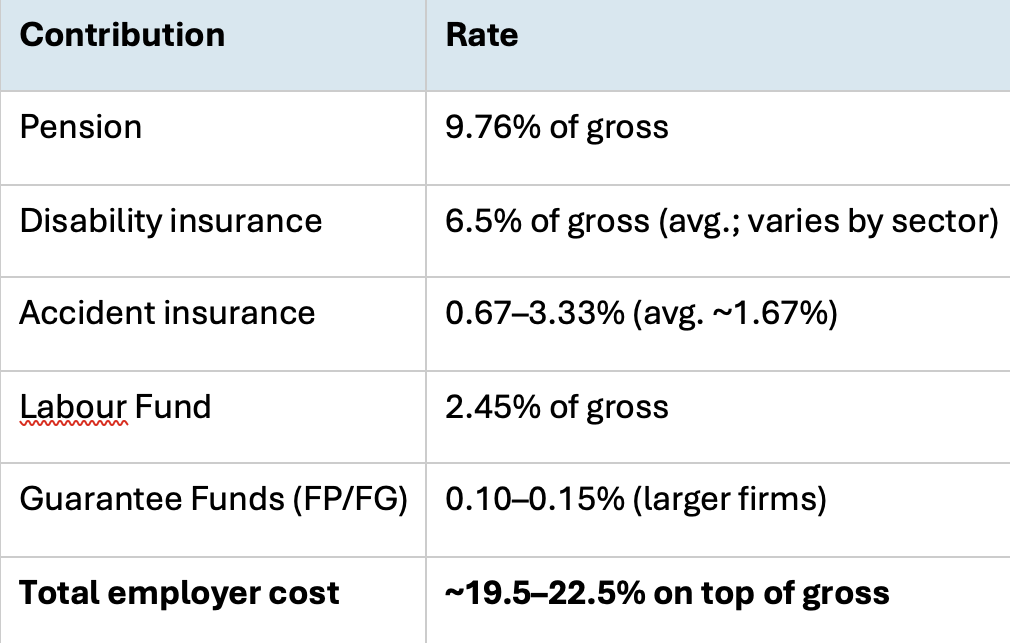
Employers are also required to register for payroll, calculate PIT on each employee’s behalf, and remit it to Polish tax authorities, even if they are a foreign company with no physical presence in Poland.
What Comes Out of the Employee’s Pay
Employees carry their own share of social contributions, deducted from gross salary before they see a zloty. On top of that, PIT is withheld progressively, 12% on annual earnings up to PLN 120,000, and 32% on anything above that.
A tax-free allowance applies, and remote work reimbursements like electricity or internet, when paid as documented lump sums, are exempt from both tax and social contributions.
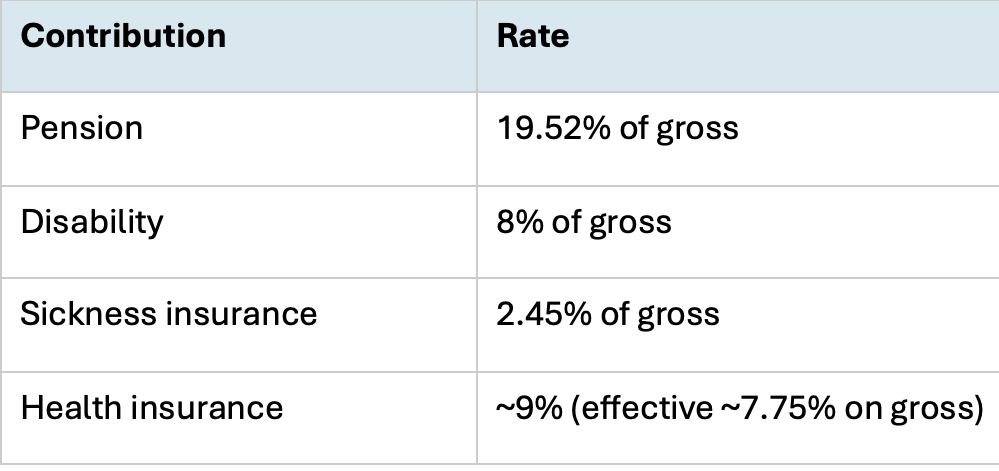
Tax residency adds another layer of complexity for international hires. Employees who spend more than 183 days in Poland during a calendar year become Polish tax residents, meaning their worldwide income falls under Polish tax jurisdiction. Those below that threshold are only liable for Polish-sourced earnings, often at a reduced rate under an applicable double taxation treaty.
Remote Pay Expectations in Poland
Poland offers genuine value for companies hiring remotely. Poland’s average monthly salary is around PLN 8,735 in 2026, but budgeting for a specific remote role requires a closer look. Compensation varies considerably by industry, seniority, and the type of contract employees prefer.
IT and Technology Salaries
Poland’s tech sector is where remote hiring is most established. One thing that catches many foreign employers off guard is the prevalence of B2B contracts. Instead of traditional employment agreements, many experienced Polish developers and specialists operate as independent contractors, and the pay difference between the two structures is substantial.
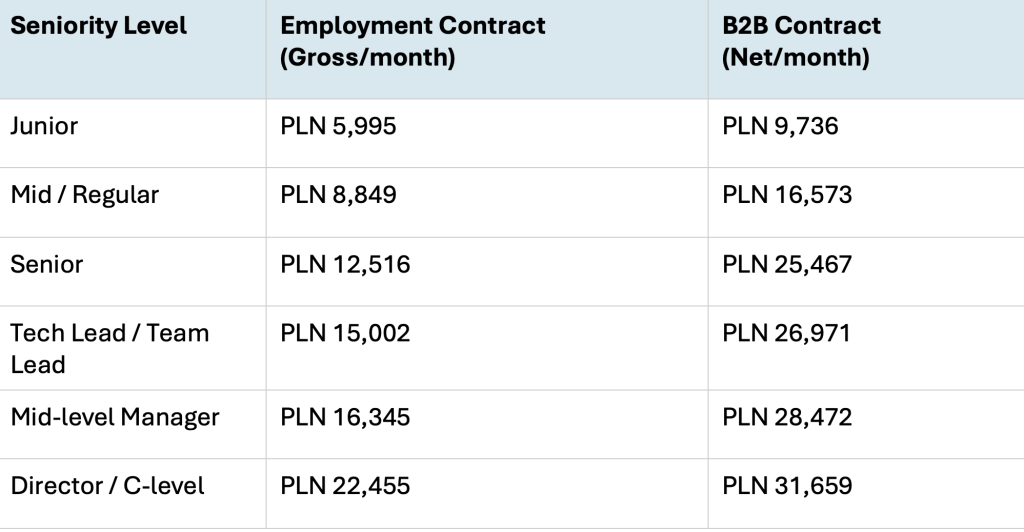
For role-specific benchmarks, annual gross figures give a more practical view of what competitive packages look like in the Polish market.

Ready to Hire in Poland in 2026?
Poland’s remote work framework is more structured than most employers expect, but that structure works in your favor. Clear rules mean fewer disputes, predictable costs, and a workforce that knows exactly where it stands. For companies serious about building remote teams in Europe, it’s one of the strongest starting points on the continent.
Finding the right people within that market is a different challenge, one that takes local knowledge and an established network.
That’s where Verita HR comes in. As a recruitment agency specializing in IT and finance talent, the team helps employers cut through the noise and connect with candidates worth hiring. The team at Verita HR can also hire and engage those talents for its clients.