
Poland has become an established destination for financial institutions building teams in quantitative analysis and risk management. But choosing a location is not simply a question of finding the biggest office market or largest graduate pool. The nature of the work an employer wants to bring to Poland matters just as much.
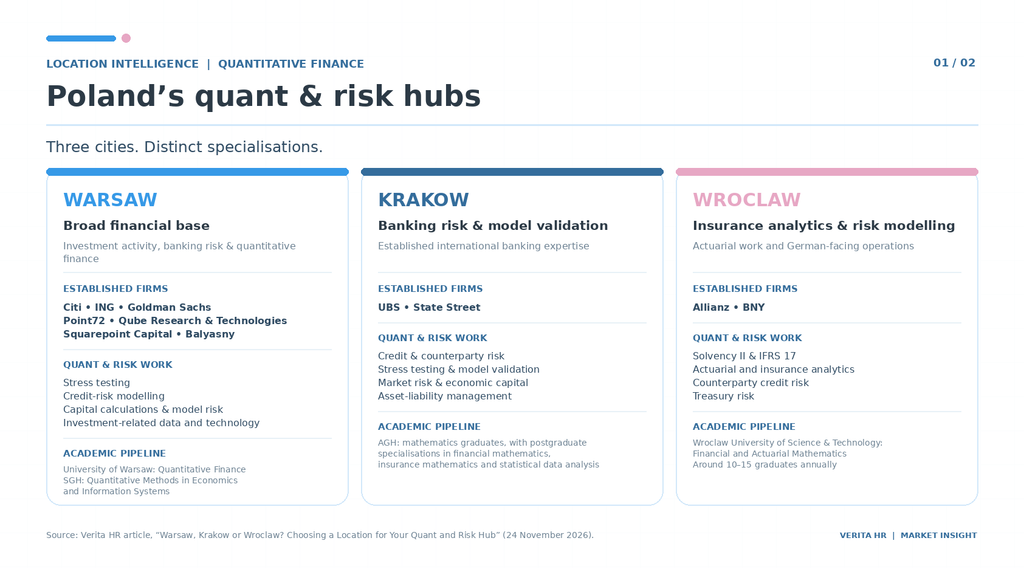
The most important distinction between Poland’s three leading financial-services centres is the type of quantitative work that has developed in each. Warsaw offers the broadest mix of financial institutions and investment activity. Krakow has a strong base in banking risk and model validation, while Wroclaw specialises in areas such as insurance analytics and risk modelling.
ABSL figures provide a useful starting point on the scale of each market. Warsaw had around 116,700 business-services employees in the first quarter of 2026, compared with 110,000 in Krakow and 71,100 in Wroclaw.
Although these figures cover far more than quantitative finance, they still illustrate the depth of the business environment in each city, where employers can draw on established pools of professionals.
Warsaw’s Broad Financial Base
Warsaw represents the most natural point for employers establishing a sizeable quantitative or risk operation in Poland. Its advantage lies in the range of institutions already present, from international banks and investment firms to domestic lenders, asset managers and regulatory bodies.
Citi illustrates the scale. Its Polish operation includes the Warsaw-headquartered Citi Solutions Center, which also has a site in Olsztyn, and Citi Handlowy. Together, they employ over 6,000 people in Poland, with Citi Handlowy alone accounting for 1,765 full-time employees in Warsaw in 2025.
Citi’s risk teams work on stress testing, credit-risk modelling, capital calculations and model risk, requiring mathematical and statistical skills alongside financial knowledge and an understanding of how models are used in regulated institutions. Warsaw also has established risk and analytics operations at firms including ING and Goldman Sachs.
Alongside banking and shared-services operations, Warsaw offers access to employers whose work is more directly connected to investment decisions. That includes firms such as Point72, Qube Research & Technologies and Squarepoint Capital, alongside the technology and data operations established by hedge funds such as Balyasny.
Recent expansion by investment firms adds to the city’s appeal. Take Balyasny’s Warsaw operation, which this year passed 100 employees, becoming one of the firm’s largest technology centres outside its main global locations. Though its growth is primarily a technology and data story, it still proves the willingness of major investment firms to build substantial technical operations in the Polish capital.
Warsaw also benefits from a strong academic pipeline. The University of Warsaw offers a two-year, English-language master’s in Quantitative Finance, with an intake of 75 students. In 2025, the programme attracted just over two applicants per place. Its quantitative finance research group also runs seminars bringing academics, industry practitioners, students and researchers together.
The SGH Warsaw School of Economics offers another route through its Quantitative Methods in Economics and Information Systems programme, which produced 271 graduates in 2024, although its curriculum extends beyond financial quantification. Together, the two universities provide access to relevant mathematical, statistical and economic training, as well as opportunities to establish relationships before recruitment begins.
The breadth of Warsaw’s financial sector is further reflected in its institutional environment. The Polish Financial Supervision Authority, National Bank of Poland and key government ministries are based in the capital. Their proximity can benefit teams dealing with regulatory requirements, as well as regional operations requiring regular contact with regulators and other financial organisations.
Krakow’s Banking Risk Strength
Krakow’s financial-services market is comparable in scale to Warsaw’s, but is more strongly associated with international banking. UBS and State Street have been particularly important to its development, alongside other established financial-services employers.
UBS employs around 10,000 people across the bank’s Polish operations and the legacy Credit Suisse business. The scale of this presence has helped establish Poland as an important location for the group’s international operations. For quantitative recruitment, the more significant point is the specialist work carried out by its Krakow teams.
This includes credit-risk modelling, counterparty risk, stress testing and model validation. These functions help banks assess potential losses, calculate capital requirements and demonstrate that their models meet regulatory expectations. They require quantitative expertise combined with a detailed understanding of banking products, portfolios and risk frameworks.
State Street adds to this concentration through its model risk management and validation work, covering credit and market risk, counterparty exposure, economic capital and asset-liability management. With several institutions requiring similar expertise, Krakow makes for an established market for professionals experienced in bank risk models and their independent assessment.
Krakow’s academic institutions provide a strong foundation for this type of recruitment.
Krakow’s academic institutions provide a solid foundation for this type of recruitment. AGH University of Science and Technology produced 92 mathematics graduates in 2024, with postgraduate specialisations in financial mathematics, insurance mathematics and statistical data analysis. The Jagiellonian University also adds to the city’s quant and scientific talent pool, alongside graduates from finance-related disciplines.
There is, however, a development worth watching. UBS is reportedly planning to move hundreds of group-function roles from Europe to India over the next few years, with most of the positions affected currently based in Poland. Any resulting changes to its workforce could bring professionals with experience in financial operations, risk control and other specialist functions onto the local job market. For employers recruiting in Krakow, this may create opportunities to attract experienced staff from an established international bank, although the scale of that opportunity will depend on which roles are affected.
Wroclaw’s Insurance Analytics Niche
Although Wroclaw has a smaller business-services workforce than Warsaw and Krakow, it still offers a unique mix of established banking operations and insurance analytics.
BNY is one of Wroclaw’s largest international employers, with around 3,000 employees in the city by mid-2024. Its local teams also undertake specialist risk-modelling work, including counterparty credit risk and treasury risk, adding banking expertise to the city’s established insurance and actuarial specialisms.
A particularly distinctive part of Wroclaw’s market is Allianz’s Quantitative Analytics operation. Established in 2019, the team supports the German insurance business, with work covering Solvency II, the European regulatory framework, and IFRS 17, the international accounting standard. Both require sophisticated modelling and actuarial expertise, illustrating how specialist financial work for international markets can be carried out from Poland.
The academic pipeline reflects this specialism. Wroclaw University of Science and Technology has offered Financial and Actuarial Mathematics since 1994. The programme is associated with the Hugo Steinhaus Centre, which supports mathematical research and collaboration, and produces around 10 to 15 graduates annually in fields including finance and insurance.
Wroclaw’s location also gives it a practical edge. The city’s position in western Poland and its established transport and commercial links with Germany make it a logical base for organisations supporting German-speaking markets, particularly those working closely with German financial institutions and insurers.
Costs and Practical Factors
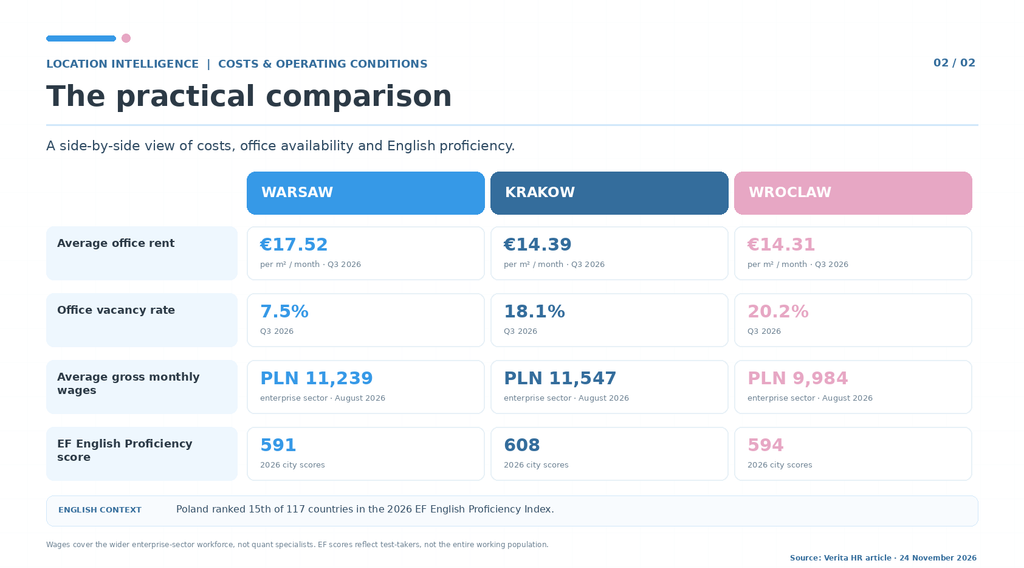
For employers weighing up the three locations, differences in operating costs may also be worth considering. Wroclaw had the lowest average wages of the three in August 2026, with gross monthly enterprise-sector earnings of around PLN 9,984. Warsaw averaged PLN 11,239, while Krakow was slightly higher at PLN 11,547. These figures cover the wider workforce, not quantitative finance specialists, but may still indicate the relative employment costs.
The office market presents another clear difference. Average office rents in the third quarter of 2026 stood at €17.52 per square metre per month in Warsaw, compared with €14.39 in Krakow and €14.31 in Wroclaw. Meanwhile, vacancy rates were around 7.5% in Warsaw, against 18.1% in Krakow and 20.2% in Wroclaw. This matters since the greater availability of space gives employers potentially greater leverage over lease terms when establishing a larger team.
Language capability is another consideration for international employers. Poland placed 15th out of 117 countries in the 2026 EF English Proficiency Index. Krakow recorded the strongest score of the three cities at 608, followed by Wroclaw at 594 and Warsaw at 591. While the index measures the performance of people who took the test rather than the entire working population, it’s still a useful indication of the language environment employers can expect when building internationally oriented teams.
Which city makes the strongest case?
The choice ultimately depends on the type of operation an employer wants to establish. Warsaw offers the broadest financial-services ecosystem and the greatest range of investment-related activity, making it a strong all-round option. Krakow stands out for banking risk, credit modelling and validation, while Wroclaw has a more specialised proposition in actuarial work, insurance analytics and German-facing operations.
For employers, the attraction is that Poland offers three established financial-services centres with distinct strengths. The best location is therefore less about choosing the biggest market and more about finding the city whose existing expertise most closely matches the team they want to build.
Verita HR works with firms on permanent recruitment and outsourcing for quant, data and technology roles. If you are mapping the market or building a team in Poland, we can give you a clear view of current compensation, realistic timelines and which profiles actually stick.
Verita HR offers services including RPO | Permanent Recruitment | Outsourcing | Media Services
Author: Michal Pawlak


