If you work in Poland today and still think AI is “just a tech thing”, you’re already behind. Banks, insurers, retailers, factories, and even the public sector are all rolling out AI projects at scale. In 2024, the number of IT-related job ads in Poland jumped by 22% compared to the previous year. At the same time, global studies show that demand for AI and machine learning skills now outpaces supply in more than 70% of the countries analysed.
Poland is no exception. Although the IT job market stabilised after the 2023 slowdown, the composition of roles has changed: classic “coding-only” positions are losing ground, while specialised roles around AI, data, and cloud are becoming increasingly prominent. The market has moved beyond simply needing more coders. Businesses now seek professionals capable of converting data into strategic decisions, and that is precisely what AI & Machine Learning Engineers do.
AI & ML Engineer Demand in Poland Now Outstrips Supply
You can see the shift clearly in current job postings. On the leading portal Pracuj.pl, offers for AI/ML Engineer, Artificial Intelligence Engineer, and Senior AI Developer are now coming from software houses, banks, industrial firms, and product companies alike. Roles are advertised by names such as Addepto (analytics), Mindbox (consulting), TRUMPF Huettinger (industrial electronics), and Bank Pekao (banking), a good cross-section of the economy.
According to a Verita HR Group report, there are more than 16,000 AI/ML specialists nationwide, including 6,400 in Warsaw, 1,800 in Krakow, and 1,400 in Wroclaw, making it one of the largest specialist groups in the country.
At the European level, AI and Machine Learning roles are already flagged as some of the fastest-growing occupations in labour-market reports and talent-scarcity studies, as the Randstad infographic below shows. One recent global survey found that around 62% of organisations struggle to hire Machine Learning engineers. Poland benefits from a strong STEM pipeline and a large IT workforce, but even in Poland, there simply are not enough experienced AI engineers to match demand from all sectors.
 Source: Randstad
This shortage is visible to employers. As Michalina Krywult, an AI recruitment specialist at Verita HR Group, explains:
“From the hiring side, it’s clear that artificial intelligence is no longer a ‘nice-to-have’ but a core driver of business transformation in Poland. Companies are not just looking for developers, they need engineers who can translate data into decisions and deliver production-ready models.”
That shortage becomes even more pronounced at the mid and senior-levels:
“The biggest challenge is the shortage of experienced specialists. Many candidates list frameworks on their CVs, but far fewer can demonstrate end-to-end pipelines and measurable business impact,” Krywult added.
And the result of that imbalance?
Companies compete for the same narrow pool of mid and senior-level AI/ML talent. Junior roles receive plenty of CVs, but true experts such as people who have delivered production models and who understand MLOps, data quality, and business impact remain rare.
AI & ML Engineer Salaries in Poland 2025
Salaries are one of the clearest indicators of real market demand. According to a 2025 AI salary report for Poland, experienced specialists earn approximately:
- AI Engineers earn around 24,000 PLN/month
- Machine Learning Engineers around 26,600 PLN/month
- Data Scientists roughly 21,800 PLN/month
Another international comparison puts Poland at the top of Central and Eastern Europe (CEE) for generative-AI developer pay, with an average salary of about $55,200 per year.
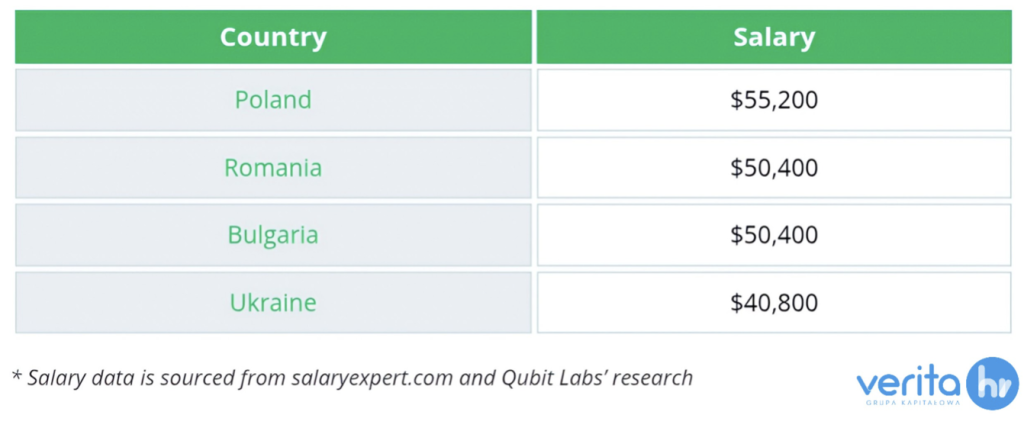
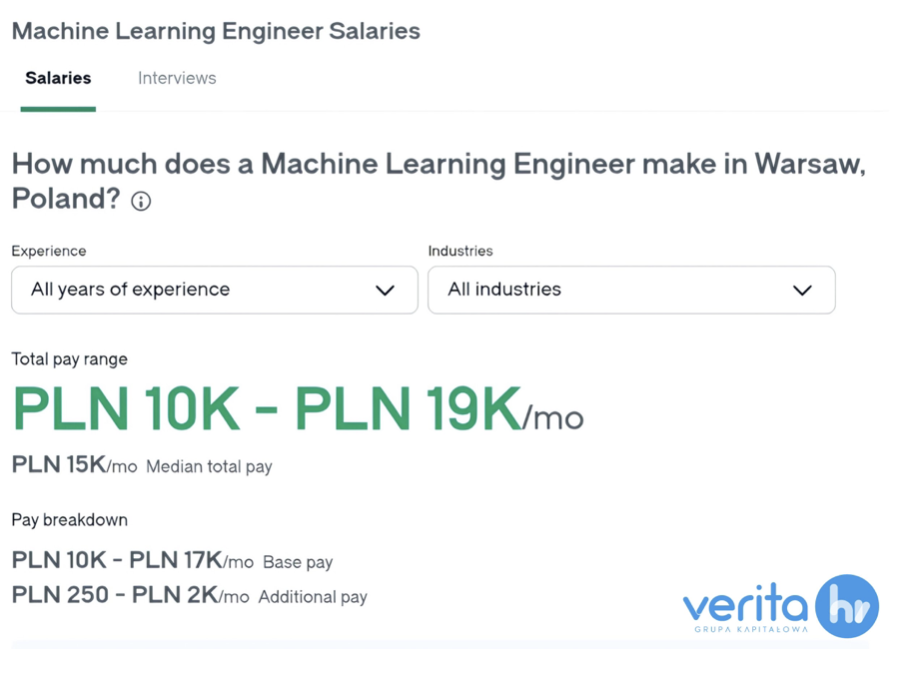
Real-time job ads confirm these levels. Current offers for AI/ML Engineers in Poland range from roughly 12,600–19,300 PLN net/month on B2B for strong mid-levels, up to 24,000–28,000 PLN net/month for senior AI/ML roles, with some senior offers reaching 18,000–28,500 PLN/month depending on contract type and location. Glassdoor’s estimate for Machine Learning Engineers in Warsaw shows monthly pay starting around 10,000 PLN and going above 19,000 PLN at the highest seniority bands.
These are not “nice to have” salaries. They are what the market has been forced to pay to secure people with real AI project experience. As Krywult notes, this salary inflation is directly tied to capability:
“That’s why salaries are rising and competition for mid- and senior-level AI/ML talent is so intense.”
 Source: Glassdoor
Which Industries in Poland Are Desperately Hiring AI & ML Engineers in 2025
It is not only Big Tech driving this wave. AI adoption is accelerating across the entire economy. Finance is using AI for credit scoring, fraud detection, and personalised offers. Manufacturing and industry are investing in predictive maintenance and quality control. Retail and e-commerce rely on recommendation engines and demand forecasting. Healthcare is testing diagnostic support and document automation. Public institutions are under pressure to digitise services and use data more intelligently.
Poland is also positioning itself as a regional AI hub. In early 2025, Google and Alphabet Chief Executive Officer Sundar Pichai, and the Polish government’s Prime Minister Donald Tusk signed a memorandum to use AI to transform strategic sectors like energy, cybersecurity, and healthcare. Similar initiatives from Microsoft and local players add to the momentum. Each one of these projects needs engineers who can design, train, and maintain models, not just talk about AI.
AI is no longer experimental; it is now part of how companies operate. With the AI sector maturing, companies need AI & ML Engineers on the payroll, not just consultants with PowerPoint slides.
Why Polish Companies Can’t Find Experienced AI & ML Engineers
Polish employers are getting more demanding. They no longer look for “data scientists” who can build a model in a notebook. They want engineers who can:
- Work with real-world, messy data,
- Ship models into production systems,
- Monitor performance and bias,
- And explain results in plain language to business stakeholders.
Across Verita HR‘s conversations with employers in Poland, one theme repeats: many candidates can list PyTorch, TensorFlow, or scikit-learn on their CV, but far fewer can walk through a production pipeline end to end and demonstrate how their work impacted a business metric.
This mirrors Krywult’s hiring-side view:
“For employers, the takeaway is simple: AI & ML Engineers are now strategic hires, not generic IT roles. Building strong teams in this area requires a deliberate recruitment strategy and investment in long-term capability.”
That gap between “course knowledge” and “production impact” is exactly why the demand for AI & Machine Learning Engineers in Poland still outweighs the supply.
How Verita HR Secures Top AI & ML Engineers
Verita HR has been recruiting in Poland’s tech and data market for over a decade. Its consultants track real salary levels for AI & ML roles and understand which profiles actually deliver in production, not just in theory. The team works with banks, fintechs, software houses, global tech firms, and telco companies that are building AI teams in Warsaw, Krakow, and beyond.
Because many of the best AI Engineers rarely use public job boards, Verita HR relies on targeted search, expert networks, and direct referrals. This approach allows the firm to reach both active and passive candidates, including those already leading AI initiatives inside Polish and international organisations.
If you plan to build or scale an AI team in Poland in 2025/2026, treat AI & Machine Learning Engineers as a strategic hire, not a generic IT role. And if you want a realistic view of the market: salaries, availability, and what you actually need, Verita HR can help you navigate the noise and secure AI & ML Engineers who are the right fit for your company’s needs.
Verita HR offers services including RPO | Permanent Recruitment | Outsourcing | Media Services